

Josh's Frogs
Why you should buy from us
Phyllobates bicolor - Black Legged Poison Dart Frog (Captive Bred)
Phyllobates bicolor - Black Legged Poison Dart Frog (Captive Bred)
$79.99
About This Product
Defining Characteristics:
- Great beginner frog
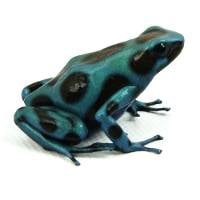
- Contrasting yellow body and black/green legs
- Very bold
- Easy to breed
- Loud call
- Large clutch size
- Social; Can be kept in groups
Name: Phyllobates bicolor. These frogs are commonly called the Black Legged Dart frog or the Bicolored Dart Frog. In the hobby, they are sometimes simply referred to as 'bicolor'. In the past, this species of poison dart frog has been known as Phyllobates chocoensis and Phyllobates melanorrhinus.
Phyllobates bicolor is one of the 'deadly 3' true dart frogs (and the second most toxic vertebrate on the planet), which are utilized by native Indian tribes in Colombia to poison darts for hunting. Fortunately, bicolor (like all dart frogs) are harmless in captivity, as they get their toxins from their wild diet.
Recommended Vivarium Size & Setup: A 10 gallon aquarium is suitable for a single bicolor, but Josh's Frogs recommends a 20H or 24x18x18 glass terrarium for 1-3 frogs.
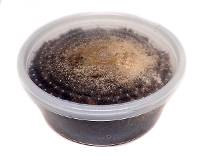
ABG mix or Josh's Frogs Dart Frog BioBedding in conjunction with our other bioactive layers (false bottom, substrate barrier, sphagnum moss and leaf litter) are great substrate options for your dart frog setup! Both of these mixes support microfauna populations, which help break down waste and mold within the tank.
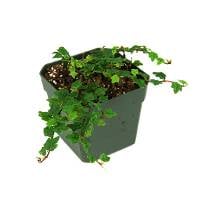
Want to spice up your enclosure with live plants? Our experts have curated kits of easy-to-care-for and SAFE plants for your dart frogs. Check them out here!
Not sure how to set up a vivarium? Check out this video: Dart Frog Vivarium Set Up - Start to Finish
Temperature (°F): They can tolerate a temperature range of 65 to 80°, but prefer temperatures in the low to mid 70s. Temperatures over 85°F are dangerous. Frogs of the genus Phyllobates are notoriously sensitive to warmer temperatures, so Josh's Frogs strongly recommends keeping temperatures in your bicolor vivarium below 75°F. Monitor temps with a digital thermometer.
Humidity: Like most poison dart frogs, bicolor prefer a humidity range of 70-100%, but can tolerate humidity down to 50% for short periods of time if the frogs have access to water. Low humidity levels, especially without access to water, can quickly be fatal. In the wild Phyllobates bicolor is often found near small streams, and takes advantage of humid microclimates. Measure humidity with a digital hygrometer.
Size: Adult female bicolor are larger, measuring in at approximately 1.5 inches. Male bicolor tend to be a bit smaller, averaging about 1.25 inches at maturity. Size is not always a good indication of sex, however—even when dealing with frogs that are several years old! All of the Phyllobates bicolor froglets Josh's Frogs sells are well started juveniles, and measure approximately 5/8 of an inch long.
Age: Phyllobates bicolor is capable of living well over 20 years in captivity under ideal conditions, although a lifespan of 10 years is more common. All bicolor for sale at Josh's Frogs are well started juveniles, and are 2-3 months old.
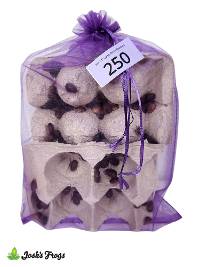
Feeding: Like most poison dart frogs, P. bicolor prefer smaller foods. All of the bicolor Josh's Frogs sells will readily eat Drosophila melanogaster fruit flies. Adults will readily consume D. hydei fruit flies as well as crickets up to 1/4 inch!. All ages of poison dart frogs will enjoy springtails and isopods. All feeder insects should be dusted with vitamin/mineral supplements.
For more information on what poison dart frogs can eat, please check out our Feeding Dart Frogs blog.
Sexing: Phyllobates bicolor is a difficult dart frog to sex until they are about a year old. Often, a frog keeper will know they have at least one male due to a loud, trilling call that starts at 6-8 months of age. Females tend to be larger and bulkier than males, but a frog will often reveal it's sex by laying eggs before their sex can be confirmed visually. Josh's Frogs sells 2-3 month old juveniles that are not sexable unless otherwise noted.
For more information on sexing poison dart frogs, please see our blogs: How to Visually Sex Dart Frogs: Part I & How to Visually Sex Dart Frogs: Part II
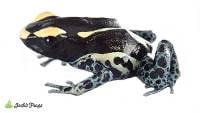
Color/Pattern: Phyllobates bicolor are not too variable, and most individuals are virtually identical to each other. When young, bicolor come out of the water as a mostly black frog with a yellow ‘U’ shape on their back. As they age, this ‘U’ spreads and eventually forms 2 complete stripes down the back of the frog. These stripes continue to spread, and eventually (around 4-6 months of age) you’ll have a frog that is mostly yellow (sometimes with an orange hue), with black feet and a varying degree of green/black spots and speckles on the legs.
Josh's Frogs does not recommend, support, or endorse line breeding as we believe this leads to weaker captive animals and nature has done a wonderful job of creating an amazing variation in color and pattern of poison dart frogs already.
Social Behavior: These frogs do well housed in groups as long as enough space is provided. In the wild, bicolor are commonly found in loose groups within a fairly small space, suggesting that they are fairly social animals (or at least put up with each other's company!). Josh's Frogs recommends approximately 10 gallons per frog. As they reach sexual maturity at 8-10 months of age, the social dynamic in a group of Phyllobates bicolor may change. Sometimes adult female bicolor will eat each other's eggs, resulting in little/no tadpoles being produced. For that reason, many breeders keep bicolor in pairs as adults in order to produce as many eggs as possible.
Josh's Frogs strongly recommends against housing different species/morphs of dart frogs—for the health of your pets, please avoid mixing!
Breeding: Phyllobates bicolor are easy to breed once they get going, and reach sexual maturity at a young age (generally 8-10 months, but I've had them breed at 6 months before!). A male will start out utilizing a long-range call, in order to get the female to come to his location. After a brief courtship, 8-20 eggs are deposited on a smooth broad leaf, or on a petri dish under a cocohut in our vivaria. The eggs hatch into tadpoles, which are transported on the back of the male to a water source, often a slow moving stream in the wild. Phyllobates bicolor tadpoles take 60-80 days to complete metamorphosis into miniature versions of the adults.
Josh's Frogs recommends purchasing multiple frogs if you are interested in breeding them–this greatly increases the chances of getting a pair (male and female).
For more information on breeding and raising poison dart frogs, please read our blog: 5 Tips for Breeding Dart Frogs
Natural Range: Phyllobates bicolor naturally occurs on the western slopes of the Cordillera Occidental in Colombia between 500 and 1,500 m elevation. Bicolor live in lowland tropical rainforests with high humidity and annual rainfall. Bicolor are commonly found near slow moving streams where they deposit their tadpoles. Considered ‘Near Threatened’ in their native lands due to habitat loss and fragmentation, Phyllobates bicolor is quite plentiful in captivity. Bicolor are also currently quite common in the wild. Like all dart frogs, Bicolor are CITES II animals, and international trade is regulated.
History in the Hobby: Phyllobates bicolor is a common frog in the US hobby, and has been present for quite some time (at least the early 1990s, if not earlier). Bicolor have been imported from European hobbyists in small numbers (sometimes even imported as Phyllobates terribilis!) This poison dart frog has suffered greatly from many boom/bust cycles due to it's ability to reproduce in large numbers, resulting in a lack of popularity that has led to a near extirpation in the US dart frog trade multiple times. This is one of those dart frogs that should be much more popular than they are, as they are a colorful, vocal species that is simple to keep and easy to breed. All Phyllobates bicolor available in the trade are captive bred - legal exportation of Phyllobates species out of Colombia has been banned since 1985.
Links of Interest:
Shipping
After placing an order containing a live animal, you will receive a scheduling email containing our JotForm scheduling link to schedule your new pet's delivery date.
With this scheduling link, you will be able to schedule your order's delivery up to 30 days in advance. You will be able to choose a date of delivery for Tuesday-Saturday (Saturday arrival depends on the carrier's service availability) with the estimated time of arrival generally being 12pm, or 4:30pm for more rural areas. Overnight lows must be above 40°F to ship directly to you (or above 30°F for FedEx Ship Center/UPS Customer Center pickups) as well as below 90°F by estimated time of arrival.
If you require further assistance, or prefer to talk to one of our Customer Service agents, please feel free to reach out to our [email protected] email or our phone line 1-800-691-8178.
Import/export restrictions on this product require that it can only be shipped to destinations within the United States.
Restrictions on this product that prohibit shipping to the following states: HI.

Customer Reviews
Review data
5 star reviews
- 0%
4 star reviews
- 0%
3 star reviews
- 0%
2 star reviews
- 0%
1 star reviews
- 0%
Reviews
1-800-691-8178

Our Team
Josh's Frogs ©2020 - 2026 by Josh's Frogs, LLC.