

Josh's Frogs
Why you should buy from us
Crested Gecko Care Sheet
Crested geckos are popular exotic animals that make great pets! Perfect for those who want a pet they can handle, crested geckos offer great personalities and require minimum care. Here is what you need to know to get started!
Nationality
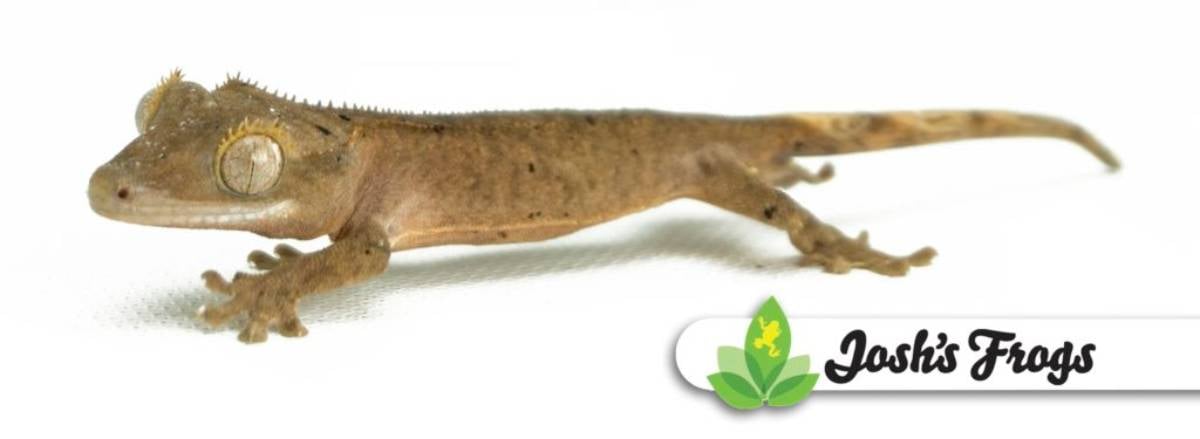
Crested geckos (Correlophus ciliatus) are native to southern New Caledonia, an island chain east of Australia. They are named after the small projections which adorn their head (as well as the top of their eyes, which has also earned them the name Eyelash Geckos).
This species was thought to be extinct in the wild until they were rediscovered in 1994. Crested geckos have since become unavailable for export, but this hardy and rewarding species has become so successful in captivity that they are one of the most widely kept geckos today.
Coloration & Patterns
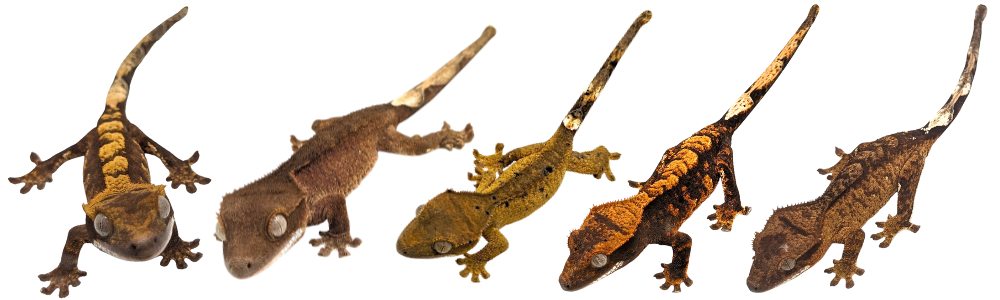
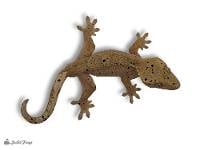
Crested geckos come in a variety of colors and patterns. They range from brown, cream, and black to oranges, reds, and whites.
Some crested geckos are patternless, while others are decorated with spots or stripes. As more generations are bred in captivity, more and more morphs (color and pattern combinations) are available. These morphs show some genetic inheritance, but they are not well 'fixed' like simple recessive traits in leopard geckos.
Housing
A single crested gecko adult or pair can be housed in a 29H gallon tank or 18x18x24 terrarium. Keeping crested geckos together in an enclosure before they're adults can be a tricky business for the inexperienced keeper: we do not recommend housing young crested geckos together as they can be territorial and aggressive towards one another—even juveniles and subadults can display aggression towards one another. It's a good idea to raise young up individually until they are sexually mature.
We also recommend avoiding having a male and female together until the female is old/large enough to healthily produce eggs.
As adults, males should never be housed together, although one male can be housed with one or multiple females provided there is enough space. If doing so, it's not a bad idea to remove the male every so often to give the girls a break.
At Josh's Frogs, we offer complete and tankless habitat kits and tankless kits that make housing crested geckos as simple as clicking the 'Add to Cart' button!

Habitat
Crested geckos are arboreal and will appreciate some height in their environment. As avid climbers, they will make use of wood branches, bendy vines, fake plants, or standing cork bark flats or tubes. For substrate, coco fiber can be used solely. We recommend Josh’s Frogs Tropical BioBedding Bioactive Substrate, which is well suited for live plants and a cleaning crew of springtails of isopods. The substrate should be kept moist, but never soaking wet.
Hailing from a subtropical region, crested geckos should be kept at temperatures between 74-78°F. While they can tolerate higher temperatures for small periods of time, they should never be kept above 85°F.
Unless ambient temperatures are consistently below the recommended range, crested geckos do not require an additional heat source. UV lighting is strongly recommended—not only will cresties synthesize D3 from ambient UVB radiation and incidental exposure, but they will also use the UVA wavelengths visible to all reptiles to properly inform basking behavior and circadian rhythm. UV lighting should feature Ferguson zone 1 levels of UV radiation, and animals should also be provided opportunities to escape from UV exposure throughout the rest of their enclosure.
Humidity plays an important role in making sure these geckos remain well hydrated and are able to shed their skin easily. Providing a reptile water bowl with clean water will ensure your gecko remains hydrated, and misting frequently with a quality mister will help keep their humidity at the ideal range of 60-70%. You can monitor humidity levels as well as temperatures, with a digital thermometer/hygrometer.
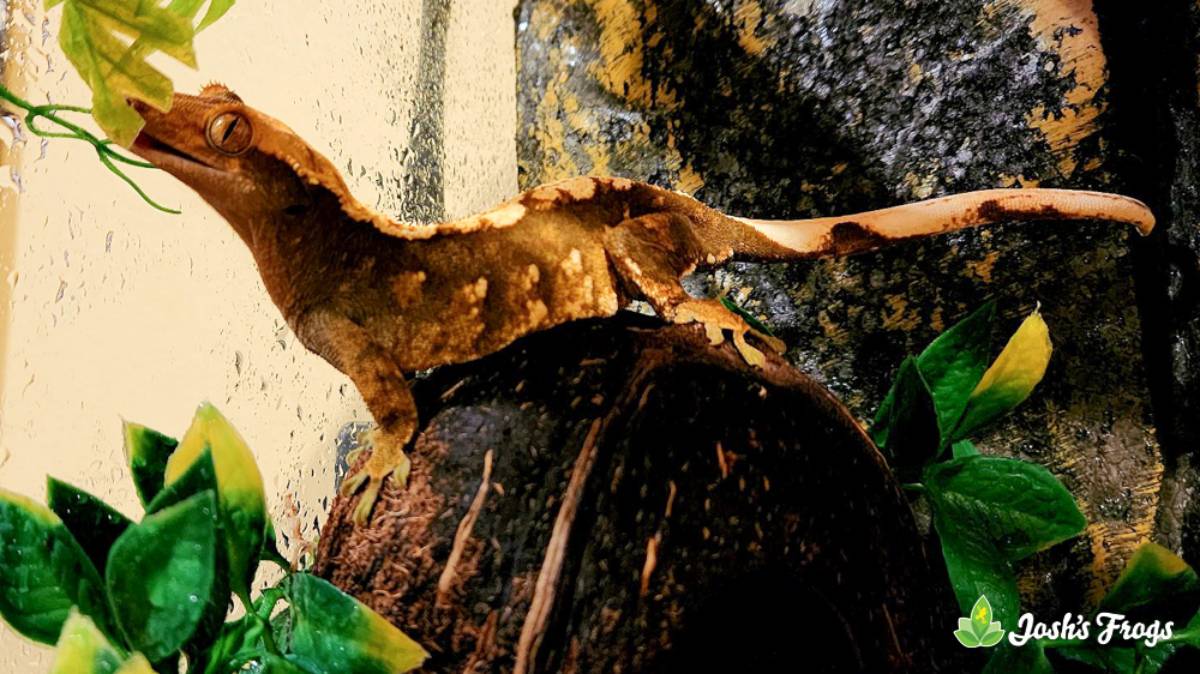
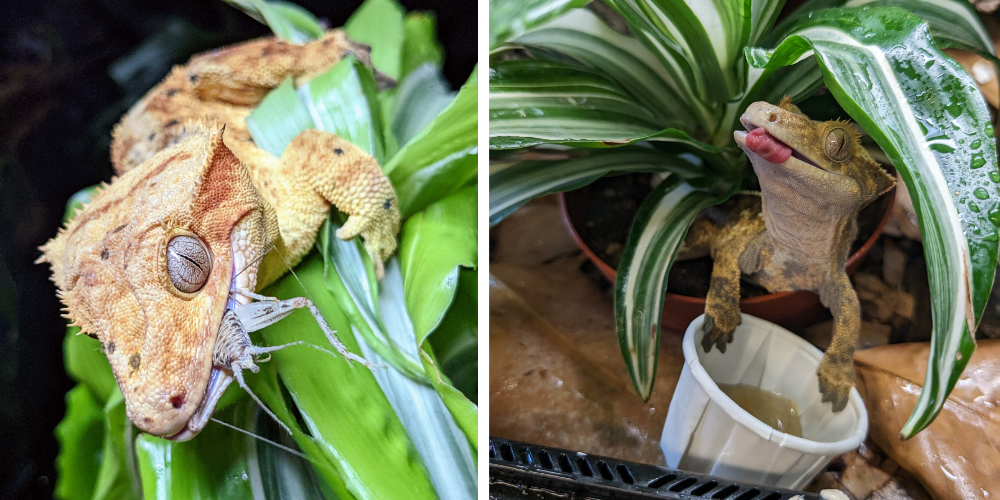
Fiona the crested gecko drinking water droplets after misting.
Size and Age
Crested geckos can reach up to 7-9 inches as adults, tail included. In the wild, crested geckos can lose their tail when feeling threatened, such as when being pursued by a predator. They can also lose their tail in captivity. After dropping their tail it won’t grow back, but these geckos thrive just as well without one.
Josh’s Frogs sells juveniles measuring about 4-5 inches. Provided proper care, these geckos can live up to 15-20 years in captivity!
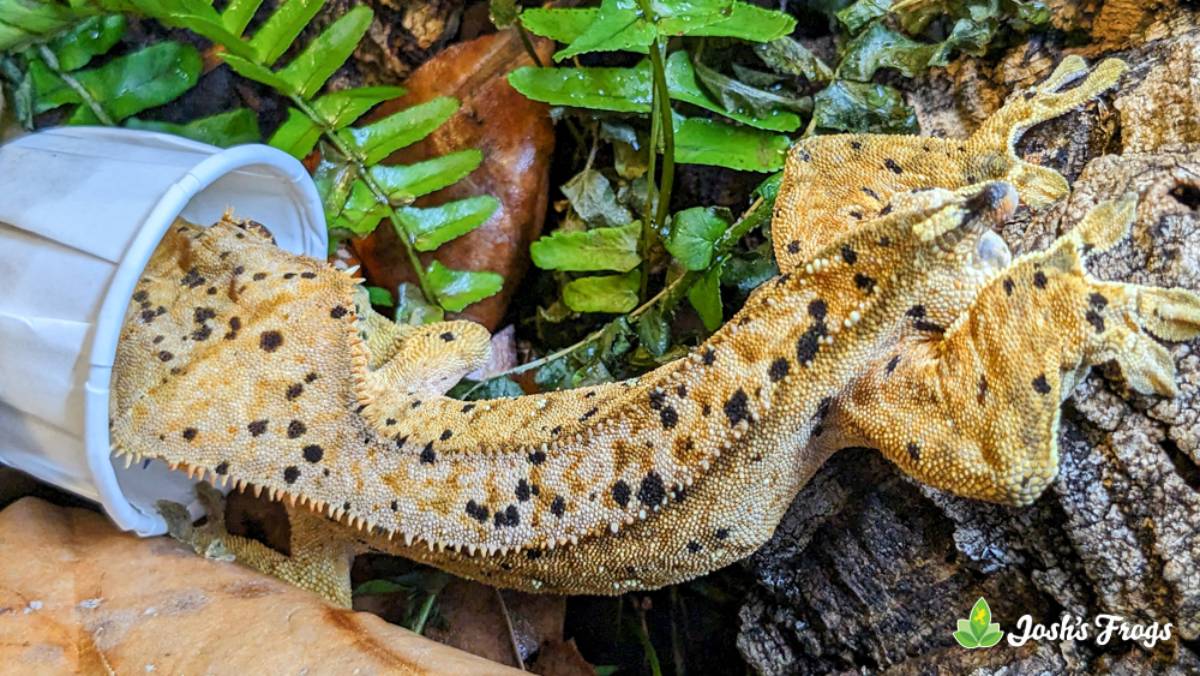
Example of a crested gecko that has dropped its tail, but it's still thoroughly enjoying dinner!
Food
Crested geckos feed on both fruit and insects in the wild. Pangea and Repashy fruit mixes offer a tailored and excellent staple for these geckos. At Josh's Frogs, crested geckos are raised on Pangea Gecko Diet with Insects. Conveniently stored as a powder, it can be mixed with water in a squeeze bottle and offered in a small plastic feeding cup.
Crested geckos can also be fed crickets or dubia roaches as part of their staple diet. At Josh’s Frogs, we offer our crested geckos crickets once a week after they have been gutloaded with Josh’s Frogs Cricket Food. Waxworms, black soldier fly larvae, and butterworms make excellent treats.
All feeder insects should be dusted with a vitamin/mineral supplement and provided using an escape-proof bowl.
Sexing
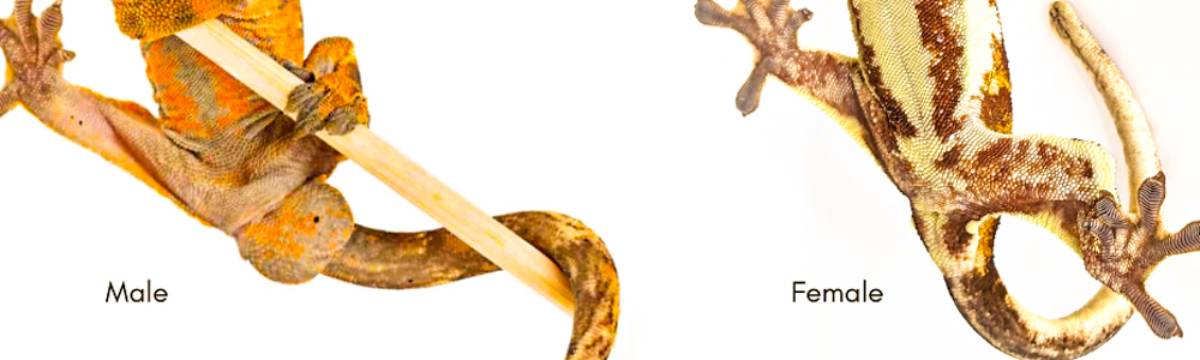
Crested geckos can be sexed fairly easily: males will have visible bulges at the base of their tail. Juveniles sold by Josh’s Frogs are not sexed. Once they are mature (1.5 - 2 years), crested geckos will breed from December to August, during which females will lay 2 eggs every 30-45 days. It is recommended to remove males from the tank to allow females to recover after the breeding season.
So, think crested geckos are the right geckos for you? Hop on over to Josh’s Frogs! Chances are we have offspring for sale right now. Our crested geckos are fed fruit mix three times a week and gutloaded crickets once a week, so they’re large, robust, and ready for their new homes!
All of our crested geckos were bred in-house, and are captive-bred from captive-bred parents. They’re all genetically diverse and descend from colorful bloodlines. They are produced by experienced herpetoculturists with over 15 years of combined experience with the genus, and come with our best in the industry live arrival and health guarantee.
What are you waiting for? Let's geck-GO!
Products in this Care Sheet



1-800-691-8178

Our Team
Josh's Frogs ©2020 - 2026 by Josh's Frogs, LLC.