

Josh's Frogs
Why you should buy from us
Chytrid Update: We're Clear!
Phew! What a relief it is to finally say those words: we're clear. It's been a grueling few months for our amphibian team and for our animals, with round after round of tests and treatments, but the grind is finally paying off. Chytrid is no longer at large in our Owosso facility, we've lifted our amphibian lockdown, and we can finally get back to what we do best: supplying our hobby with happy, healthy, captive-bred frogs.
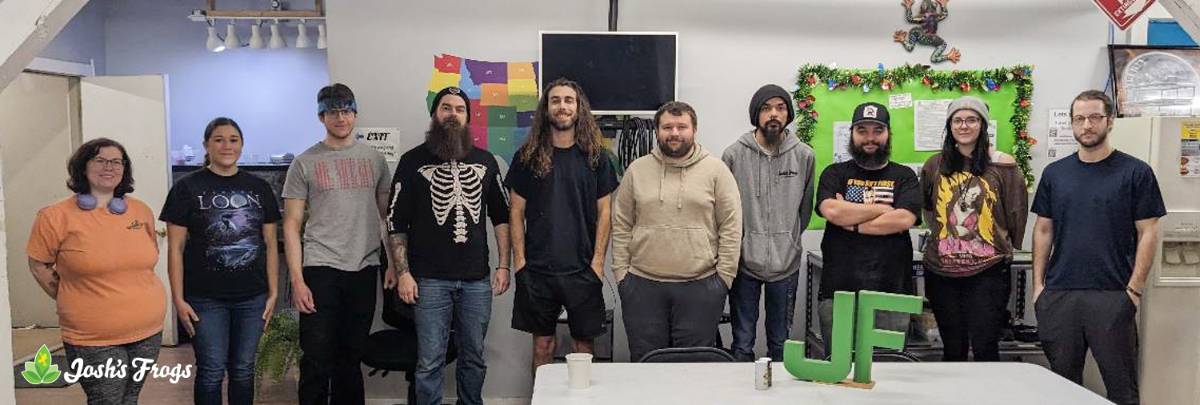
Our toad-ally tad-rific amphibian team, from left: Holly, Grace, Vaughn, Rick, Seth, Brandon, Kevin, Josh, Katie, and Jacob
Once we identified chytrid outside of our quarantine rooms, we knew we had our fight cut out for us. Our singular focus shifted to getting the spread under control with minimal loss of frogs. Thanks to our rock-solid team, and a great deal of help from some very smart academic and government stakeholders, we were able to get through it. Now with the worst behind us, we look forward to sharing our experience. We do so with the belief that the lessons we've learned and the data we've gathered can empower a better, healthier, and more sustainable pet trade.
That belief is shared by many of the smart and talented people who helped us through this ordeal, people without whom we likely would have given up and to whom we owe a great deal of thanks. At the top of this list is Dr. Matthew Gray. Together with his colleagues at the University of Tennessee and the Healthy Trade Institute, he made himself an open book for our team to study, sharing a trove of knowledge on everything from the latest chytrid research and the biosecurity protocols that he uses in his own lab, to the sheer mathematics of tracking pathogens in one of the world’s largest amphibian collections. Then there’s Chad Lytle and the folks at Research Associates Laboratory, who provided us with the same excellent PCR testing services for which they’re known, even at the massive scale that we required. Beyond professional, his transparency and willingness to answer all of our questions, no matter how basic, is praiseworthy.
Notwithstanding our lapses of protocol that allowed chytrid to escape quarantine in the first place, it’s a testament to our strong biosecurity practices that throughout our efforts to contain it, symptomatic frogs have remained so rare in our facility. To date, of the roughly 12,000 amphibians in our collection, only about 40 ever developed symptoms that could be attributed to chytrid, or 0.3%. This percentage, known as the symptomatic proportion, has puzzled many of our academic partners, including Dr. Gray. It shows just how insidious chytrid can be, especially in collections of this size. We certainly made mistakes, but if not for our policy of routine testing, we likely wouldn’t have discovered those mistakes in time to save our animals.
It’s also worth noting that we’ve tested and cleared our entire amphibian collection, not just the portion that we thought to be at risk. As soon as we found chytrid outside of quarantine, we made the hard decision to treat every amphibian as potentially chytrid positive. Of course, this would make the testing and treatment process much more expensive and time consuming, but we knew it was the right thing to do. Nothing could be left to chance, so no amphibians were ruled out.
At Josh’s Frogs, we never let a good mistake go to waste. This one has definitely made us stronger. It might make our hobby stronger, too. It’s no revelation to say that strict quarantine and routine testing are essential practices for a responsible pet trade. If anything, the magnitude of our slipup simply underscores that point. The greater value of our experience is how it can inform a standard model of operation to sustain our hobby well into the future. For the pet trade to truly call itself responsible, we need to turn best practices into standard practices. We need a shared playbook for what to do when accidents happen, as they inevitably will. We need to learn from each other and help each other. To that end, we’re working closely with the Healthy Trade Institute to make a case study of our experience. The data we've collected will inform development of their Healthy Trade Certification Program.
Looking forward, what's next for our amphibians? Obviously, lockdown has put our breeding efforts a few months behind. Prioritizing the health and safety of our frogs meant missing some key breeding events. Fortunately, amphibians are prolific breeders, and we’re eager to bounce back even stronger. Expect amphibian availability to improve steadily over the next few weeks and months.
We're also working on blogs to cover chytrid in more detail. Expect to see those very soon. We weren’t exactly unfamiliar with it before, but our recent struggles with this fungal pathogen have been very educational, and not just for us. They’ve given leading chytrid experts a rare opportunity to collect valuable data and put their theories to the test. We fully intend to share everything that comes of this important work. Some will be well established information. Some will be at the very forefront of current research. All of it will be good for the responsible hobbyist to know, so stay tuned!
Topics in this Blog
1-800-691-8178

Our Team
Josh's Frogs ©2020 - 2026 by Josh's Frogs, LLC.